What Tiger Barb Fin Nipping Looks Like And Why It Happens
Tiger barb fin nipping is a common community tank problem where Puntigrus tetrazona repeatedly bites other fish fins and sometimes tails. The behavior often starts as exploratory or social, but it can become persistent when stress and poor layout remove escape options.
Fin nipping may show up as quick pecks that keep returning, rather than a one-time incident. Over time, fraying edges and missing fin rays can appear, especially on fish with long or flowing fins.
What Fin Nipping Looks Like In Community Tanks
- Short, repeated bites to fins and tails
- Fraying edges and missing fin rays over time
- Nipping targets slow or long-finned fish first
- Behavior may increase during feeding or peak lighting
Also, the same individuals often become the repeated target when school size is too small. As a result, other fish may look calmer while one fish is stressed and kept moving.
Stress Versus Instinct Based Aggression
Fin nipping often increases under stress conditions like unstable water, tight space, or constant disturbance. Then the usual roaming behavior shifts into more chasing, which keeps fins within reach.
Additionally, reduced schooling can cause the group to patrol more like individuals than a unit. When that happens, territorial cues appear more often in cramped spaces.
Key Triggers That Make Tiger Barbs More Likely To Nip
- Small school size and uneven social structure
- Inadequate swimming space and hardscape congestion
- Inconsistent water quality or unstable temperatures
- Overly aggressive or slow tank mates creating conflict
- Long fasting intervals before a big feeding
Because the behavior depends on opportunities, even good tank mates can get targeted if they move slowly. Therefore, fixes must address both group behavior and the physical tank layout.
How School Size And Social Structure Affect Fin Nipping
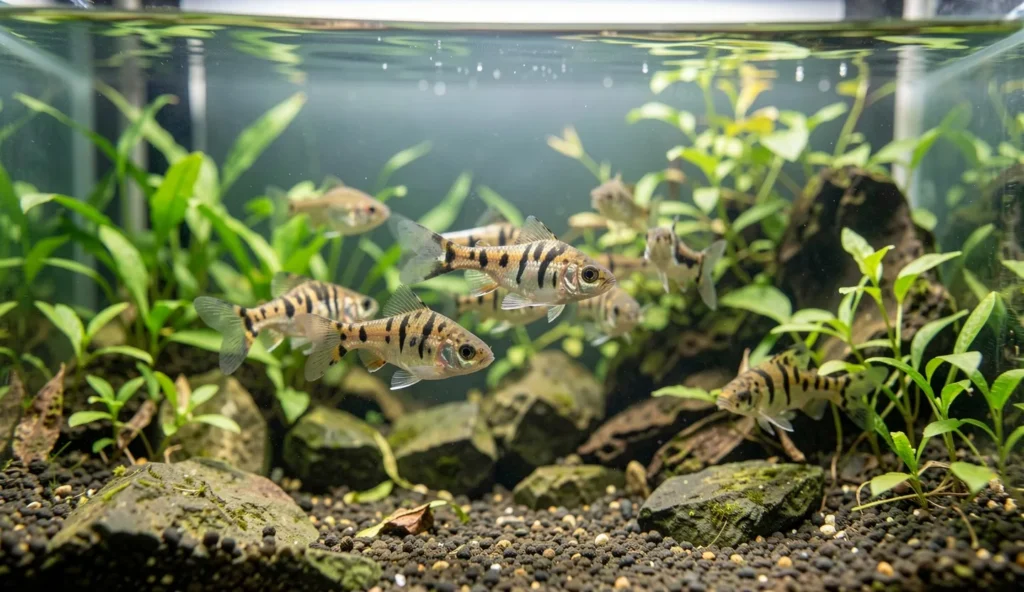
School size strongly shapes how an aggressive barb interacts with the rest of the community. When tiger barb schooling stays steady, chasing spreads through the group and the same fish no longer receive constant attention.
At the same time, social structure matters, because new fish can disrupt roles within the school. If the group feels unstable, pursuit becomes more directed and fin nipping rises.
Recommended School Size For Tiger Barbs
- Bigger groups reduce directed chasing at tank mates
- School size should increase with tank volume
- Avoid odd counts that create dominance clusters
- Introduce new barbs to the same size class
In practice, larger schools let fish spend more time in group movement rather than single-file patrolling. If the school size is too small, attention concentrates, and fins become easy targets.
Keeping stable community dynamics also helps explain why some keepers see better results after improving tank routines. Similar group-focused principles also appear in guides like neon tetra schooling behavior, where group cohesion reduces stress signals for small fish.
How To Add More Tiger Barbs Without Starting A Fight
- Quarantine if adding from separate sources
- Add gradually or in a single planned batch
- Keep lights dim during the first day when possible
- Feed multiple small meals to keep focus on food
When additions come from a different supply source, stress can rise even if water tests look fine. For that reason, quarantine helps limit disease and reduces sudden behavior spikes.
Also, adding fish during the same short window prevents long periods where only a few new individuals chase. Multiple small feedings during adjustment can reduce exploratory fin biting that happens when the tank is quiet.
What Changes When The Group Size Is Still Not Enough
- Chasing may persist even with a larger group
- Targets often remain the same individuals
- Behavior can spike after cleaning or rescapes
- School may spread unevenly across the tank
If tiger barb fin nipping continues, the issue often sits in both group size and available space. Next steps should include tank measurements, aquascape distance, and feeding timing before buying more fish.
Tank Size And Layout That Reduce Fin Nipping
Space reduces pursuit, and a good layout helps the school keep moving without repeatedly lining up with target fins. For tiger barb keepers, tank size planning matters as much as stocking, because a congested aquascape creates easy chase routes.
Additionally, line-of-sight interruptions keep long pursuits from turning into repeat attacks. When fish can break sight and escape paths appear, fin nipping often declines.
Minimum Tank Size Guidance Based On School Size
- Choose longer tanks for horizontal swimming
- Increase space as the group gets larger
- Avoid crowding near the substrate and corners
- Match filtration capacity to bioload
Longer footprints tend to support school movement, because barbs can spread laterally. If the tank feels narrow, chasing can become constant, especially near glass.
When bioload rises, oxygen and filtration failures can intensify stress behavior. Therefore, maintaining filtration output keeps aggression tied to food rather than discomfort.
Even bottom dwellers can benefit from better planning, since crowding near the substrate can create tension. For community ideas in similar freshwater setups, corydoras catfish care often emphasizes how space and hiding areas reduce day-to-day conflict.
Hardscape Placement That Creates Breaks In Pursuit
- Use hiding cover without fully trapping slow fish
- Create multiple swim lanes using rocks and plants
- Avoid tight corridors where chasing repeats
- Distribute shelters so all fish can access cover
Hardscape should support escape movement, not dead ends. If fish must pass through narrow gaps to reach open water, the school can repeatedly intercept them.
Also, rescapes can trigger behavior changes because fish re-map territory cues. After any aquascape work, fin nipping may rise temporarily until the school stabilizes.
Plant Choices And How Dense Aquascaping Helps
- Use live plants for cover and surface shading
- Add midground plants to interrupt line-of-sight
- Balance plant density with oxygen and flow
- Keep maintenance routines consistent after planting
Dense midground growth often reduces the chance that a slow fish stays in plain view. As a result, the barb school spends more time schooling through cover and less time locking onto fins.
However, plant density still needs airflow and light balance. If plants reduce oxygen exchange, stress rises, which can increase nipping behavior.
Lighting And Water Flow Settings That Can Influence Aggression
- Avoid overly bright lighting over uncovered areas
- Use gentle flow to prevent exhaustion during chasing
- Maintain stable temperature to reduce stress behavior
- Keep flow patterns predictable during daily routines
Overly intense lighting can cause fish to remain active in open zones for longer. Therefore, dimmer lighting over swimming routes can reduce repeated exposure to pursuit.
Stable heat also limits stress, since temperature swings affect metabolism and irritation. When the tank runs smoothly, the school keeps a more uniform rhythm.
Best Feeding Practices To Lower Biting Pressure
Feeding routines can control whether tiger barb behavior stays food-focused or turns into exploratory fin chasing. When food intake is irregular, barbs often roam longer, and that increases the chances of targeting fins.
Also, uneven feeding can cause competition spikes, especially when multiple species reach for the same zone. When portions spread out, fin nipping drops because the tank becomes less about chasing.
What Tiger Barbs Typically Need In A Community Setup
- Balanced diet with protein and plant components
- Varied foods to reduce boredom and repeated behaviors
- Sinking and surface options to spread feeding time
- Offer portions that finish within a short window
Variety helps keep the school occupied, because consistent hunting patterns depend on smell and taste changes. For example, when pellets and flakes arrive at different depths, the school rotates through positions more naturally.
When tank mates include species with different feeding niches, it helps to understand their normal behavior first. Guides like plecostomus fish care often note how algae grazing shapes daily movement and feeding zones.
Feeding Schedule Adjustments That Reduce Nipping
- Use smaller, more frequent feedings
- Avoid long gaps between meals
- Feed before stressful events like rescapes
- Remove leftovers to protect water quality
Shorter feeding windows reduce the time barbs spend searching for food when competition looks high. As a result, fin nipping often declines after a week of consistent timing.
Also, remove uneaten food quickly to protect water quality. Poor water increases stress response and can make even normal interactions feel sharper.
How To Feed When Other Fish Are Long-Finned Or Slow
- Scatter feeding to reduce crowding at one spot
- Use multiple feeding zones in the tank
- Time feeding to keep barbs engaged with food
- Ensure slow fish can reach food without being cornered
Scatter feeding spreads attention away from any single fin target. Therefore, slow-moving fish can eat without being forced into open areas.
When the tank includes territorial types, a feeding plan can prevent chasing from spreading to multiple species. For handling ideas around temperament differences, betta fish care commonly emphasizes how stable routines reduce conflict with active tank mates.
Choosing Tank Mates That Avoid Long-Fin Conflict
Some community species reduce fin nipping risk, while others increase it by slowing down or carrying long fins. The most common problem pattern comes from combining slow fish or delicate fin types with an active schooling fish.
Also, similar-sized active fish can increase competition cues, which can push tiger barbs toward chasing. When selecting tank mates, matching swimming zones matters more than just choosing compatible water parameters.
Which Tank Mates Are Most Likely To Get Nipped
- Long, flowing fins are common targets
- Slow-moving fish are chased more often
- Fish that rest in open water attract attention
- Similar-sized, active fish increase competition cues
Even if the long-finned fish acts healthy, the repeated biting can cause stress and infection risk. Therefore, slow recovery times or frequent fin fraying suggests a mismatch.
How To Match Species That Tolerate Active Barbs
- Pick fish that swim in different zones
- Choose faster, midwater dwellers when possible
- Avoid adding very calm species into busy schools
- Use the same introduction order to reduce dominance fights
Midwater dwellers often share space without hovering in one spot. When fish occupy different lanes, the barb school spends energy on schooling rather than selecting one target.
When tank mates are livebearers, their behavior can shift quickly during breeding and recovery. If the community includes livebearing fish, swordtail fish breeding behavior can show how activity rises around new fry and changes routine movement.
What To Do If Nipping Starts After Adding A New Fish
- Separate the injured fish if fins worsen
- Check school size and tank space first
- Review water stability after the addition
- Consider temporary feeding changes during adjustment
New fish can cause brief re-sorting within the school, which can increase chasing. If fin loss accelerates over 48 to 72 hours, action should be immediate rather than waiting for recovery.
Troubleshooting Fin Nipping With Clear Decision Steps
A structured approach helps experienced community keepers fix tiger barb fin nipping without random changes. Instead of guessing, each step should confirm one variable at a time and track results.
That method also prevents stress stacking, where multiple changes happen at once and behavior becomes harder to interpret.
Step 1 Check Water Quality And Stability
- Verify ammonia and nitrite are zero
- Confirm nitrate levels stay in a safe range
- Check temperature swings from heaters or room changes
- Inspect oxygen and filter output
Water problems can silently raise stress before visible aggression appears. When tests show unstable parameters, fin nipping can continue even if the tank looks well planted.
Step 2 Confirm The Tiger Barb School Size And Layout
- Increase group size when possible
- Add hardscape breaks so chasing paths are not direct
- Reduce crowding at feeding stations
- Ensure schooling space across the tank
When schooling looks uneven, fish may patrol edges and repeatedly intercept the same targets. Therefore, layout changes should focus on swim lanes and escape routes.
If other community fish have long fins, their swimming style may make them appear like easy prey. For color and activity considerations in similar community planning, platy fish color morphs help illustrate how livebearers can behave differently in shared midwater lanes.
Step 3 Review Feeding Amount And Schedule
- Adjust to smaller, more frequent meals
- Provide variety and include plant-based components
- Use feeding strategies that reduce competition
- Remove uneaten food promptly
Feeding should occupy the group quickly, because time without food encourages roaming. When food reaches multiple zones, chasing often loses focus.
Step 4 Assess Tank Mates And The Fin Damage Rate
- Track which fish are targeted and how fast
- Relocate the target fish if damage progresses
- Swap tank mates that repeatedly get nipped
- Consider rebalancing the community if conflicts persist
Damage rate matters more than a first bite, because healing requires time and low stress. If fin loss continues after group and layout fixes, tank mate selection likely needs revision.
Step 5 Decide When Temporary Separation Or Rearing Increases Survival
- Isolate fish with severe fin loss to prevent infection
- Use a hospital tank with stable parameters
- Reintroduce only after group and layout fixes
- Avoid repeatedly moving fish during ongoing stress
If fins worsen quickly, separation can prevent bacterial or fin rot problems. After stabilization, reintroduction should occur only when school size, space, and feeding routines support peace.
Starter Checklist For Keeping Tiger Barbs Without Fin Nipping
A checklist reduces mistakes and helps experienced keepers set up for tiger barb success. When the tank supports schooling from the start, fin nipping often never becomes a long-term pattern.
Setup And Group Planning Checklist
- Plan for larger school size from the start
- Use a longer tank for horizontal swimming
- Add plants and rocks to create multiple swim lanes
- Prevent tight corners where chasing loops form
- Ensure filtration and oxygen support the full stocking
Daily And Weekly Habits Checklist
- Feed small portions several times per day
- Offer varied foods to keep hunting behavior food-focused
- Keep water parameters stable with consistent maintenance
- Watch for first signs of fraying and adjust quickly
- Quarantine new fish to prevent adding stressors
These habits support both Puntigrus tetrazona health and community calm. When routine stays predictable, aggression tends to focus on normal schooling.
What To Monitor After Making Tank Changes
After improvements, the key outcome is reduced targeting and faster fin recovery. In addition, schooling should spread across multiple zones instead of funneling toward one fish.
Signs The Fixes Are Working
- Less repeated chasing of the same fin target
- Fins stop degrading and healing begins
- School movement spreads across multiple zones
When these signs appear, tiger barb fin nipping usually becomes manageable with steady maintenance. Keep monitoring for a few days after each change to confirm the cause.
Frequently Asked Questions
What School Size Reduces Tiger Barb Fin Nipping Most Effectively?
Larger schools spread attention and reduce directed fin chasing.
Do Tiger Barbs Nip More In Small Tanks Or Crowded Layouts?
Cramped space increases stress and makes pursuit more constant.
What Tank Mates Are Least Likely To Have Fins Nipped By Tiger Barbs?
Fish with shorter fins and faster, different swimming zones tend to be safer.
How Should Feeding Change To Reduce Aggressive Barb Behavior?
Use smaller, more frequent feedings to keep the group focused on food.
How Long Should It Take For Tiger Barb Fin Nipping To Improve After Tank Changes?
Improvement often shows within days once space, group size, and feeding are adjusted.
Should Injured Fin Fish Be Separated From The Tiger Barbs?
Separation can prevent further damage if fin loss is progressing quickly.
Final Note On Reducing Fin Nipping In Community Tanks
With the right school size, tank space, and feeding routine, tiger barb behavior can settle into normal schooling. Consistent adjustments backed by observation typically deliver the strongest results.