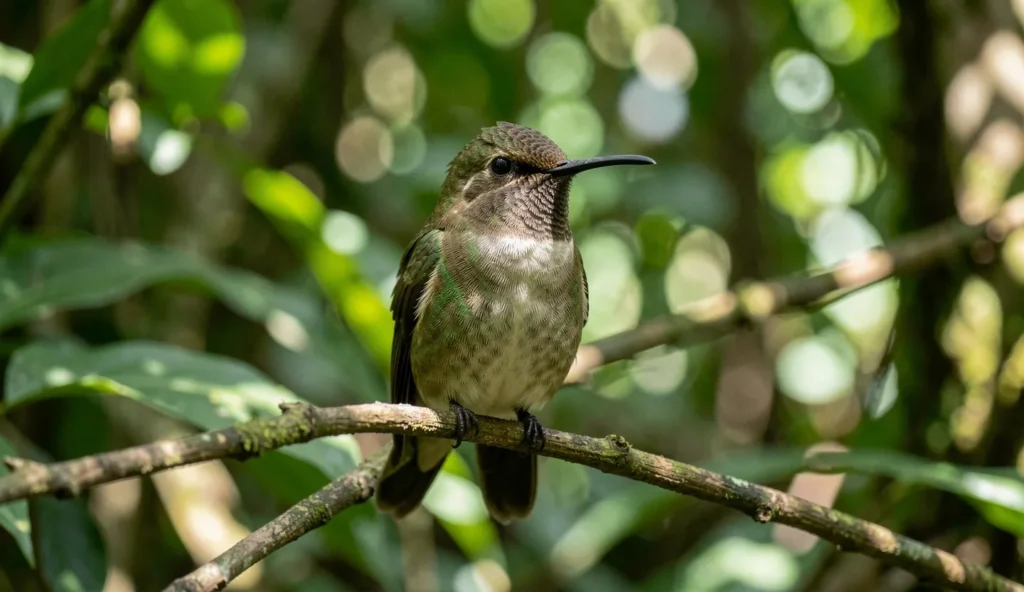
What Is a Long-Billed Hermit
The Long-Billed Hermit is a hummingbird species native to humid forests across Central America. This small bird is notable for its exceptionally long curved bill.
Taxonomy and Classification
The Long-Billed Hermit belongs to the hermit hummingbirds in the genus Phaethornis. It is a small to medium sized hummingbird with a notably long curved bill.
Its scientific name Phaethornis longirostris appears in many field guides, helping researchers identify this distinctive species. The Long-Billed Hermit is a key example of the group’s adaptive foraging strategies.
Key Traits At a Glance
- Long decurved bill adapted for deep nectar sources
- Dull green and brown plumage provides camouflage
- Secretive nectar feeders with distinctive foraging patterns
Its specialized bill shape mirrors long-billed nectar specialists like the Sword-billed Hummingbird, illustrating convergent adaptation in nectar feeding.
Appearance and Physical Features
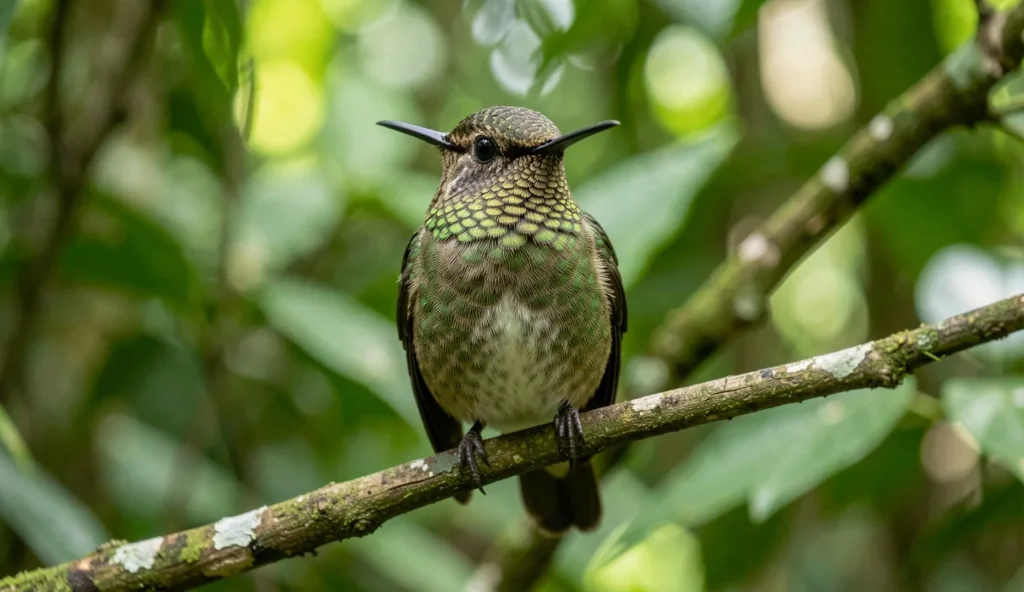
The Long-Billed Hermit shows subtle coloration that blends into shaded habitats, a trait common among hermits. Overall, plumage tends toward muted tones that reduce visibility to predators and rivals.
Bill and Beak Structure
The Long-Billed Hermit has an extremely long, slender, and curved bill. This adaptation allows access to nectar from tubular flowers that other hummingbirds cannot probe.
The bill shape facilitates efficient nectar access from deep corollas, a hallmark of this species and its relatives.
Plumage and Coloration
Colors are typically dull compared with more showy hummingbirds, exhibiting greenish-brown tones that blend with forest shadows. Such dull colors help camouflage the bird while foraging in dense understory foliage.
For context on color variation among nectar feeders, see species like the Plain-capped Starthroat, which demonstrates how plumage can reflect different habitats and behaviors.
Behavior and Feeding Habits
Behavior centers on patient, methodical foraging in the forest understory, where long bills access nectar from specialized flowers. The Long-Billed Hermit also consumes small insects to meet energy needs.
Feeding Patterns
- Nectar feeding from a variety of understory flowers
- Insects supplement diet, especially during breeding
For broader nectar strategies, compare this species with other long-billed hummingbirds like the Plain-capped Starthroat and the Lucifer Hummingbird to understand habitat-driven foraging differences.
Vocalizations and Interactions
Vocalizations are soft, consisting of chirps and high-pitched notes, which birds use to mark territories and attract mates. Generally solitary, the Long-Billed Hermit remains wary of conspecifics during foraging bouts.
Habitat and Range
Geographically, the Long-Billed Hermit inhabits humid forest zones across a broad stretch of Central America. The species prefers shaded areas with abundant flowering plants and dense understory cover.
Geographic Range in Central America
Found across humid forest zones from southern Mexico through parts of Central America, the Long-Billed Hermit favors regions with reliable nectar sources. Its distribution is tied to forest integrity and flowering plant availability.
Preferred Habitat Microhabitats
Understory and mid-level foliage near nectar sources are favored, with shade-tolerant, semi-open forest edges supporting foraging activity. These microhabitats provide both concealment and access to a variety of blossoms.
Observers often notice this species around flowering clusters that thrive in disturbed yet protected areas, which is why good viewing opportunities occur in reserves and protected forests. To learn about how different habitat types influence feeding, explore articles like the Blue-throated Hummingbird for a contrast in range and behavior.
Care and Maintenance Tips
Observers should focus on non-intrusive monitoring that minimizes stress to the bird while providing a window into its ecology. Practical strategies center on respecting distance and habitat health.
Diet and Nectar Sources
- Diverse nectar sources; rely on multiple plant species when possible
- Insect protein supports energy needs and breeding
In the field, it helps to diversify nectar sources; this mirrors approaches used by other nectar specialists such as the Lucifer Hummingbird and Blue-throated Hummingbird to ensure resilient observation opportunities.
Observing Etiquette and Ethical Considerations
Observe from a respectful distance to avoid stress, and do not disturb nests or lure birds with aggressive feeders. Responsible watching preserves natural behavior and habitat integrity.
Is a Long-Billed Hermit Right for You
This species suits observers who enjoy patient, deliberate birding focused on behavior and foraging adaptations. The Long-Billed Hermit reveals how long bills shape niche use in tropical forests.
Ideal Observer Profile
Patience for slow-paced birding and a strong interest in behavior and long bill adaptations suit enthusiasts of the Long-Billed Hermit. The Long-Billed Hermit can be rewarding for those who study foraging tactics in quiet settings.
Fit for Habitat Checklist
Access to tropical forests or protected reserves and a willingness to observe without disturbing wildlife are essential considerations. This species thrives where forest health supports diverse nectar plants.
Final Note
Final Thoughts
The Long-Billed Hermit offers a subtle but fascinating glimpse into nectar ecology and specialized foraging.
Frequently Asked Questions
What makes the Long-Billed Hermit unique among hermit hummingbirds?
It features a longer, more curved bill that suits specialized nectar foraging.
Where are Long-Billed Hermits typically found in Central America?
They inhabit humid tropical forests across Central America, often in shaded understory zones.
How long is the bill of a Long-Billed Hermit and why is it adapted?
The bill is long and decurved to probe deep into tubular flowers for nectar.
Are Long-Billed Hermits rare and why?
Yes, they are relatively rare due to limited habitat and ongoing forest loss.
What should a hobbyist know about observing Long-Billed Hermits ethically?
Observe from a distance, avoid nests, and respect local protections and habitats.
What is the main diet of the Long-Billed Hermit besides nectar?
Insects and spiders provide essential protein alongside nectar.