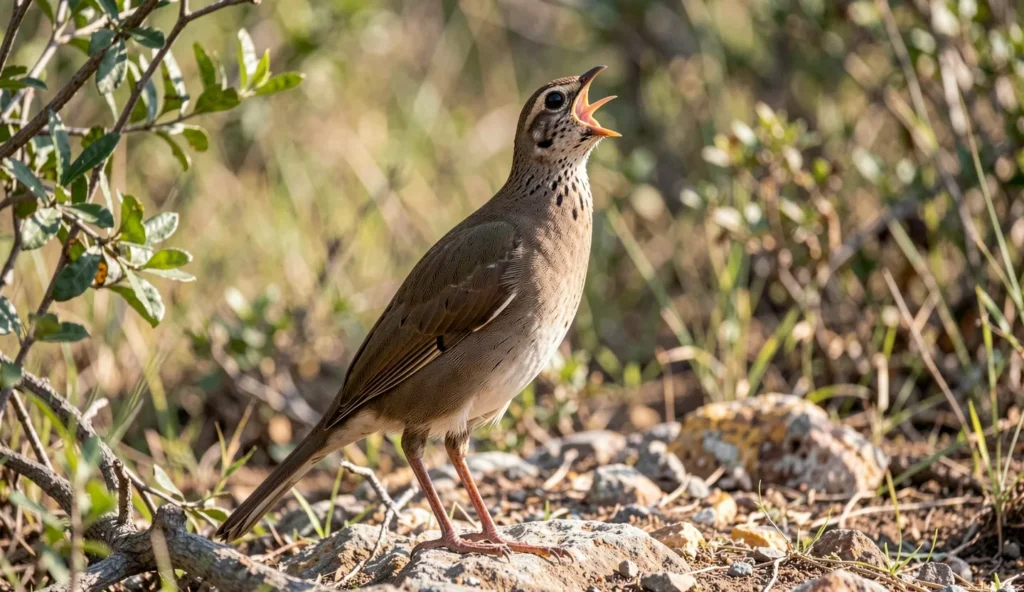
What Is Hildebrandt Francolin
Hildebrandt Francolin is a ground-dwelling francolin found in parts of East and Southern Africa, where it relies heavily on vocal communication. It stands out for loud, repetitive calls that support territory marking and spacing between nearby birds.
Because vocalizations carry well over grassland and woodland edges, bird sound enthusiasts often use calls for field identification by calls. For context on how francolins differ across regions, it also helps to compare other species like Grey Francolin.
Where the Hildebrandt Francolin lives
Hildebrandt Francolin lives across East and Southern Africa, typically in areas where ground cover supports safe movement. It often occurs in grassland, scrub, and woodland edges where vegetation breaks line of sight.
Sound transmission changes with habitat structure, so calling can sound different in open areas versus thicker cover. Vegetation also alters perceived bird sounds, especially high-frequency details.
What the bird sounds like at a glance
Hildebrandt Francolin calls are loud and repetitive, and they often sound like persistent phrases rather than a long continuous song. Bird sound enthusiasts usually notice that the calls maintain a steady pace during active moments.
These francolin vocalizations support territorial communication, so the bird may call from a perch, then repeat at intervals. Timing and repetition help set expectations for when calls should return.
Vocalization basics for first time listeners
Call versus song matters because francolins often use short, repeated call phrases instead of complex melodic sequences. In practice, listeners should focus on repetition, pace, and call duration as identification cues.
Distance also changes perceived loudness and clarity, so a nearby caller may sound sharper than a distant one. Even when the timbre shifts, repetition and pause timing usually remain recognizable.
What Makes Hildebrandt Francolin Vocalizations Stand Out
Hildebrandt Francolin vocalizations are designed for detection, which helps explain why the calls are delivered loudly. In many settings, repeated phrases increase the chance that another bird hears the message.
These communication patterns also help reduce direct conflict by signaling presence without immediate contact. That spacing function appears across ground birds, including species discussed in Black Francolin call behavior.
Loud repetitive calling and its purpose
Territory marking calls often come from a consistent area, with the bird repeating the same phrase to reinforce boundaries. Spacing between birds improves because other individuals can locate a caller without approaching blindly.
Repeated delivery also increases detectability in noisy, uneven habitat. Interestingly, loud calls can reduce escalation since the message arrives quickly.
Common call qualities that help identification
Pitch range provides a baseline listening cue, but it is rarely the only factor for certainty. Rhythm and call length often matter more for reliable identification.
Call length and pause pattern help listeners separate similar-sounding birds. When multiple clips share the same dominant phrase structure, field identification by calls becomes more confident.
How call behavior changes through the day
Calling often peaks in morning and early evening, when background noise and activity patterns support communication. During harsher weather, calls may reduce because transmission and visibility drop.
Activity level also influences how often calls occur, especially when the bird forages nearby or shifts position. If there is movement in the habitat, clusters of calls may follow.
Hildebrandt Francolin Call Types and When They Happen
Hildebrandt Francolin calls work best when paired with behavior, because vocalizations often map to territorial or social situations. Bird sound enthusiasts can improve accuracy by grouping calls into practical categories.
Many francolin vocalizations follow a predictable rhythm, so attentive listeners can anticipate call returns after a quiet period. Similar ground-calling patterns appear in species like Painted Francolin, which can help with comparative rhythm practice.
Territorial calls for spacing between birds
Territorial calls typically deliver repetitive phrases from a likely perch area or from ground near cover. Calls can increase when another bird is near, especially if the intruder remains within hearing range.
Territorial calls often start after a quiet period, which makes the first repeat phrase stand out. The bird may keep calling while staying in place, then pause again to reassess.
Response calls during encounters
Response calls happen when a nearby bird answers, and the Hildebrandt Francolin may shift from solo calling to a back-and-forth pattern. Short bursts can follow another bird’s call even before movement is visible.
Because responses can start quickly, listeners should watch for whether call phrases appear to trade timing. That pattern supports communication rather than random calling.
Call bursts during active periods
During active periods, calling can occur in clusters, meaning multiple phrases arrive close together. Clusters make it easier to locate an active individual, since the bird repeats rather than giving a single call.
Burst timing may correlate with movement and foraging, because the bird often calls while staying within a familiar patch. For similar wet grassland settings and secretive calling styles, see Swamp Francolin for comparison.
How To Identify Hildebrandt Francolin Sounds in the Field
Hildebrandt Francolin sound identification improves when listening focuses on consistent structure rather than one-off details. Bird sound enthusiasts benefit most from tracking repetition, phrase shape, and pause timing over short sessions.
Many confusion cases happen when other ground birds use repetitive calls, so the goal is to build a reliable checklist before concluding. Comparisons to other calls can also be guided by broader bird sound behavior discussed for different taxa, such as pigeon vocal patterns in Trumpeter pigeon.
Listening cues that matter most
Track repetition rate and consistent spacing, because the same caller usually keeps a stable rhythm. Next, listen for the dominant phrase structure and whether it returns with similar length.
Cadence changes can also confirm the same caller, especially when the pause between phrases remains steady. If a second bird enters, the rhythm may shift but the underlying pattern for each caller often stays consistent.
Recording tips for clearer bird sound identification
Choose an unobstructed spot for the microphone so wind noise and muffling stay lower. Record short segments with clear pauses, because context helps separate one call phrase from another.
Log time, weather, and approximate distance so later review links sound quality to conditions. When review includes that metadata, patterns become easier to verify across multiple clips.
Avoiding mix ups with other francolins and ground birds
Many ground birds call repetitively, so identification should compare rhythm and phrase repetition rather than focusing on volume alone. The habitat and location also help, since different francolins occupy different microhabitats.
Cross-checking with where the sound comes from supports accurate conclusions. It also helps to practice phrase matching against known species like Grey Francolin using memory of pacing and pause timing.
What to do when the sound seems distant or muffled
Distance and vegetation reduce perceived clarity, and vegetation can lower higher frequencies that carry detail. In those cases, listeners should prioritize rhythm and pause timing instead of trying to judge timbre.
Repeated phrases remain the most reliable cue, because their structure survives even when the sound becomes softer. When multiple clips share the same rhythm, the identification signal strengthens.
What Drives Vocalization and Communication in Francolins
Francolin calls function as communication signals that shape spacing, mating readiness, and daily interactions. For Hildebrandt Francolin, loud repeated phrases support territory marking calls that keep neighbors informed.
Understanding why the bird calls helps listeners interpret what they hear. It also clarifies why call intensity can vary across conditions like weather, background noise, and time of day.
Territory marking and mate related communication
Loud calls help maintain boundaries by advertising presence to nearby birds. Calls can also align with breeding readiness, which may increase overall calling intensity during certain seasonal periods.
Because season influences behavior, the same area may produce fewer phrases outside peak reproductive timing. That seasonal change helps explain why francolin vocalizations vary from month to month.
Social spacing and reducing direct contact
Calls signal presence without requiring physical approach, so birds can avoid unnecessary close contact. Repetition increases the chance the message gets through, especially when visibility is poor.
When birds respond to each other, the interaction often prevents escalation. Response timing can also reflect how far apart individuals remain.
Environmental factors that shape call patterns
Wind and rain reduce effective transmission, so the bird may call less or shift delivery behavior during poor conditions. Open ground allows sound to travel farther, which can affect how quickly a bird expects a reply.
Time of day also changes background noise levels, so calling can sound more prominent during quieter hours. Even when bird sounds change due to conditions, the core call structure often stays recognizable.
Starter Setup for Bird Sound Enthusiasts Tracking Hildebrandt Francolin Calls
A systematic approach helps turn listening into usable evidence, especially when calls repeat across a site. This starter setup focuses on simple tracking steps for Hildebrandt Francolin vocalizations and bird sound enthusiasts monitoring sessions.
Over time, consistent logging makes it easier to compare clips and notice patterns. It also supports learning call behavior without relying on guesswork.
Field checklist for sound focused outings
Bring a phone or audio recorder with an external mic option if possible, since it improves clarity. Use a notebook or notes app to capture time, location, and habitat notes immediately.
Plan early morning and late afternoon sessions because those windows often show higher calling activity. Wear quiet clothing and move slowly to avoid extra background disturbance.
- External mic or recorder for cleaner bird sounds
- Notebook or notes app for time and habitat details
- Early morning and late afternoon listening sessions
- Quiet clothing to reduce movement noise
How to organize recordings for later review
Label files with date, time, and habitat notes so each clip stays traceable. Keep multiple short segments rather than one continuous recording, since segments help isolate specific call phrases.
Mark suspected call start and end points in notes to speed up later review. This practice also supports comparing repetition and pause timing across different days.
- File names with date, time, and site label
- Short clips with clear pauses between calls
- Notes for weather and approximate distance
- Markers for call starts and ends
How to compare recordings without overcomplicating
Compare repetition and pause spacing first, because these features hold up across distances. Then check whether dominant phrase structure matches across multiple clips.
Use consistency across clips as evidence, rather than judging one loud recording. Treat background noise as a variable that can explain differences, not as proof of a different bird.
- Start with repetition rate and pause spacing
- Verify dominant phrase structure across clips
- Use multiple recordings for stronger confirmation
- Account for background noise and cover
Frequently Asked Questions
When does the Hildebrandt Francolin usually call the most?
Calls often peak early morning and late afternoon, and weather plus activity level can change call rate.
What type of vocalizations is the Hildebrandt Francolin known for?
Hildebrandt Francolin is known for loud, repetitive calls that support territory marking and spacing.
How can Hildebrandt Francolin calls be identified from other birds?
Listeners can focus on rhythm, repetition rate, and pause timing, then compare phrase structure across multiple clips.
Why does the Hildebrandt Francolin call repeatedly in one area?
Repeated calling signals presence to other birds and supports territory boundaries and spacing.
Do Hildebrandt Francolin calls sound different when it is far away?
Distance usually makes calls softer and less detailed, but rhythm and repetition remain useful cues.
A Practical Way to Use Vocalizations for Field Identification
Hildebrandt Francolin vocalizations work best when treated as patterns, not single sounds, since repetition carries the strongest identification signal. With careful listening and basic recording notes, Hildebrandt francolin calls become easier to match to territory marking behavior over time.