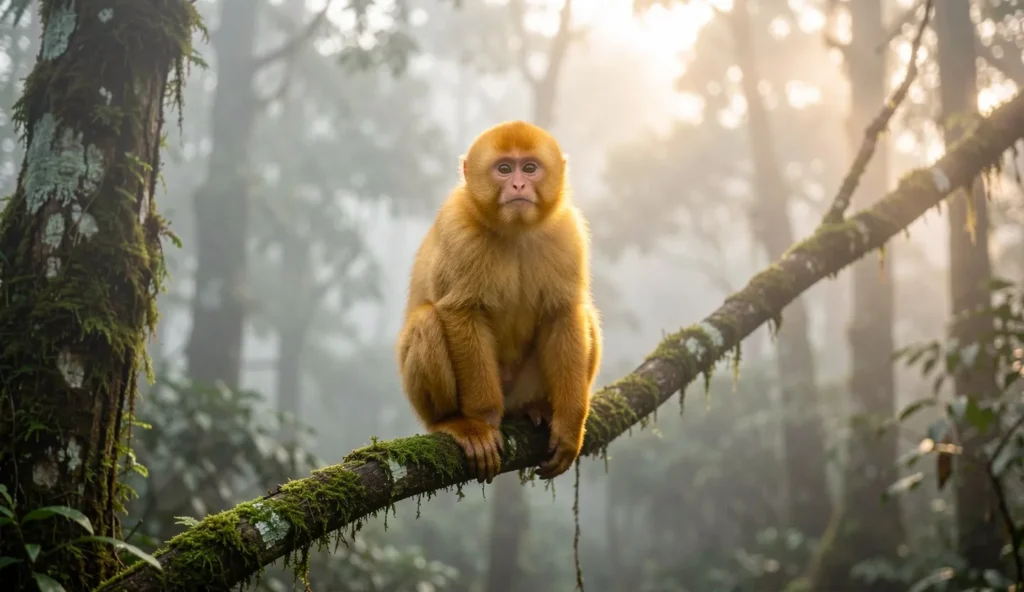
What Is a Golden Snub Nosed Monkey
The Golden Snub-Nosed Monkey is an Old World primate native to high-altitude forests in central China. This species is noted for its upturned nose and a rich golden coat that helps withstand cold, misty environments. It is essential to recognize why this animal cannot be kept as a pet and how conservation efforts support its survival.
In studying related species such as the Rhesus Macaque Breed, researchers gain insight into social dynamics and habitat needs that differ from the Golden Snub-Nosed Monkey.
Species Classification
- Scientific name Rhinopithecus roxellana
- Belongs to Old World monkeys in the family Cercopithecidae
- Part of a genus known for distinctive facial features
Native Range
- Endemic to high elevation regions of central China
- Ranges across Sichuan, Shaanxi, and neighboring provinces
- Lives in rugged montane forests with seasonal snow
Appearance and Physical Features
The species is instantly recognizable for its dense, golden fur and a compact, stocky build adapted to cold temperatures. Its facial features are distinctive, including an upturned nose that gives the species its common name.
For readers familiar with other primates, the Crab-Eating Macaque offers a point of comparison in facial structure and social signaling.
Coat Color and Fur Texture
- Dense golden to reddish fur
- Guard hairs add a subtle sheen
- Coat remains insulating in cold high-altitude climates
Distinctive Facial Traits
- Upturned nose is a key identifier
- Dark facial skin contrasts with fur color
- Expressive eyes aid social signaling
Habitat and Range
These monkeys occupy temperate forests at elevations typically between 1,700 and 3,100 meters, where cool, misty conditions shape daily activity. Seasonal changes influence movement and foraging patterns.
Geographic distribution spans multiple Chinese provinces, with habitat fragmentation a continuing concern for connectivity and genetic exchange. Conservation corridors are essential for maintaining viable populations and long-term survival.
Altitude and Climate
- Found at high elevations with cool temperatures
- Misty conditions influence foraging behavior
- Seasonal climate shifts drive altitudinal movements
Geographic Distribution
- Spread across several central Chinese provinces
- Habitats are unevenly distributed due to terrain and human activity
- Conservation zones support habitat protection and corridor maintenance
Diet and Feeding
Wild diets include a mix of leaves, buds, fruit, seeds, bark, and occasional insects, with protein intake rising during insect-rich periods. Diet composition varies with seasonal availability and habitat quality.
In terms of foraging, large groups coordinate to locate food resources, while selective feeding reduces competition within the troop. A diverse diet supports adaptation to changing seasons.
Typical Foods
- Leaves and buds
- Fruit and seeds
- Bark and occasional insects
Foraging Behavior
- Large groups coordinate food searches
- Seasonal availability shapes choices
- Diet breadth aids resilience in harsh climates
Social Structure and Behavior
The Golden Snub-Nosed Monkey lives in complex, multi-level social groups with clear hierarchies. Strong social bonds help stabilize groups in challenging environments.
Communication relies on vocalizations and facial expressions, while grooming reinforces alliances and reduces tension. Seasonal movements can alter social interactions and group cohesion.
Group Dynamics
- Multi-level social organization
- Large groups with structured relationships
- Social bonds sustain group cohesion
Communication and Social Bonds
- Vocal cues and facial signals convey intent
- Grooming strengthens alliances
- Seasonal shifts influence interaction patterns
Is a Golden Snub Nosed Monkey Right for You
Legal status places these animals under strong protection, and pet ownership is not feasible due to specialized care needs. Ethical considerations emphasize conservation over private ownership, especially in areas where illegal trade remains a threat.
Conservation concerns stem from habitat loss and fragmentation, and ongoing research supports habitat protection and recovery efforts. Public awareness can drive meaningful change for native Chinese monkeys and their ecosystems.
Legal Status and Pet Safety
- Illegal to own in China and many regions
- Specialized care required beyond typical pet care capabilities
- Private ownership fuels illegal wildlife trade
Conservation and Ethical Considerations
- Endangered status reflects habitat loss and fragmentation
- Conservation supports habitat protection and research
- Public awareness drives positive change
Frequently Asked Questions About Golden Snub Nosed Monkey
Why is the Golden Snub Nosed Monkey endangered?
Habitat loss, fragmentation, climate change, and poaching contribute to declines.
Where do Golden Snub Nosed Monkeys live?
They inhabit temperate, high altitude forests in central China, mainly Sichuan, Shaanxi, and Gansu.
Are Golden Snub Nosed Monkeys kept as pets?
No, they are protected by law and require specialized care, making pet ownership illegal in most regions.
What do Golden Snub Nosed Monkeys eat in the wild?
Their diet includes leaves, buds, fruit, seeds, bark, and occasional insects, depending on the season.
Final Note
Efforts to protect this high altitude primate rely on habitat preservation and informed public engagement. Supporting credible conservation programs helps safeguard the future of the Golden Snub-Nosed Monkey.